In 2018, Rockstar Games released a title that would go on to reshape the conversation around narrative in open-world games. Red Dead Redemption 2 arrived as a prequel to the beloved 2010 western, but it quickly carved out a legacy all its own. Eight years later, the industry still looks to Arthur Morgan’s journey as a benchmark for character writing, moral complexity, and emotional payoff. While the community buzzes with rumors of a third installment, the anniversary of the second game remains a moment for reflection—not just on what was achieved, but on why it continues to resonate.
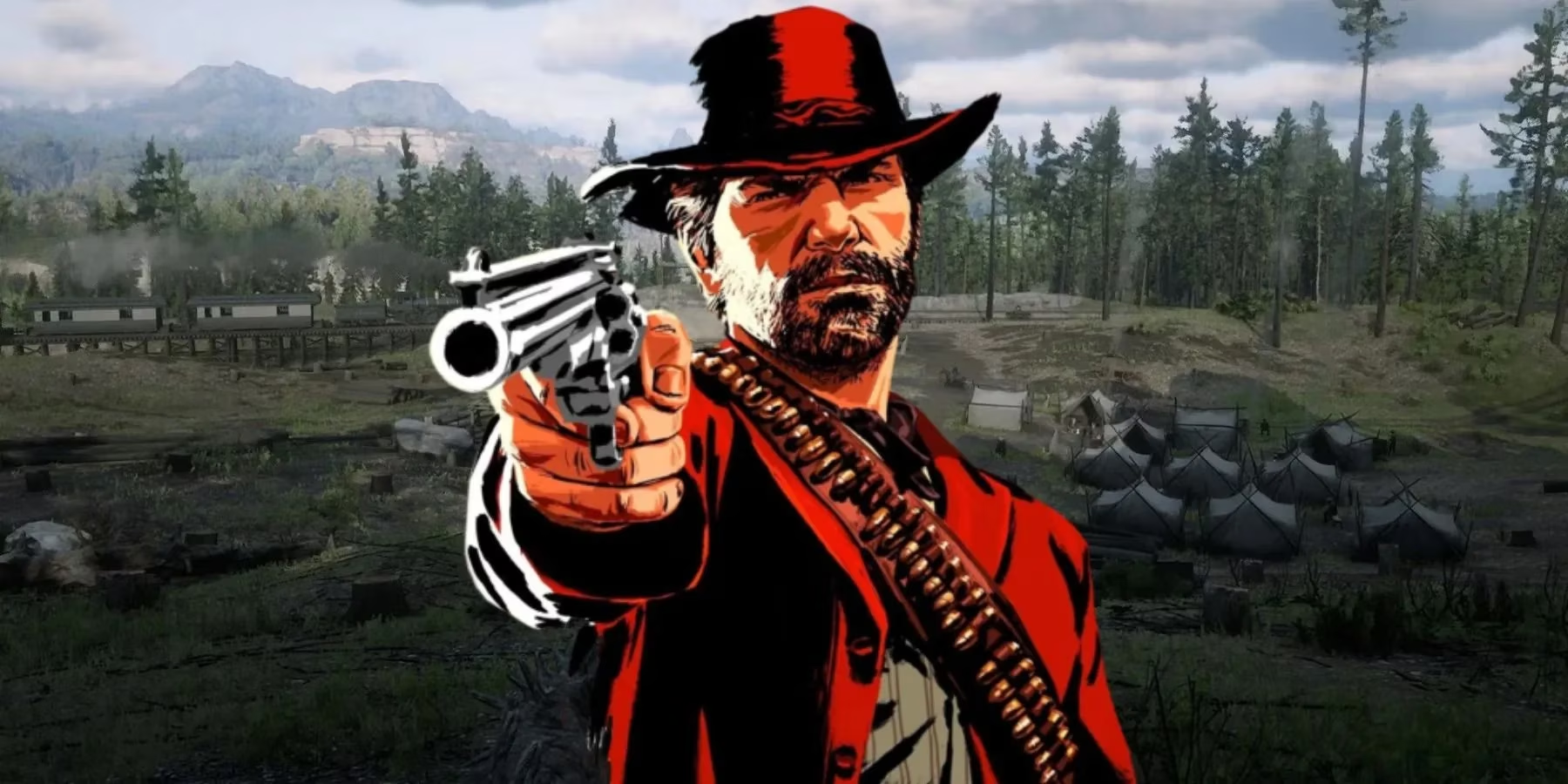
From the beginning, Red Dead Redemption 2 was an ambitious undertaking. It evolved from the cult classic Red Dead Revolver and took the open-world formula that Grand Theft Auto had perfected, transplanting it into a meticulously crafted vision of the dying American frontier. The result was a game that felt alive in ways few others have managed. Wildlife roamed with believable patterns. Towns bustled with citizens who remembered your face and your misdeeds. Weather systems rolled over the mountains with an almost painterly beauty. But while the technical achievements were staggering, they served a greater purpose: to immerse players in a world where Arthur Morgan’s story could unfold with devastating weight.
On the surface, Arthur Morgan was just another outlaw. He was Dutch van der Linde’s right hand, a hulking enforcer who followed orders and collected debts with brutal efficiency. Yet Red Dead Redemption 2 spent its lengthy runtime peeling back those layers. Arthur was a man who had always defined himself by loyalty—to the gang, to Dutch, to a code that felt increasingly hollow as the sun set on the age of outlaws. His arc was not one of a hero discovering righteousness, but of a flawed man recognizing the rot in his own life and making a conscious, painfully human choice to do better. It was a rare portrayal of change that felt unforced, born not from a dramatic event but from a slow accumulation of doubt, guilt, and quiet observation.
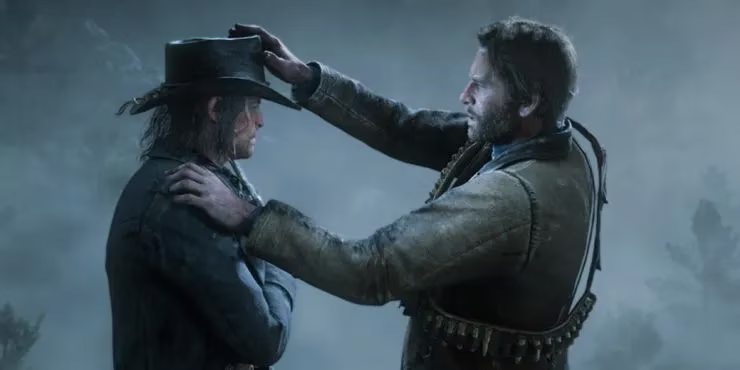
Contrasts with the first Red Dead Redemption only illuminate Arthur’s depth further. John Marston’s story was driven by external pressure—his family held hostage, his past dragging him back into violence. He fought to escape the outlaw life, and his tragedy lay in never truly being allowed to. Arthur, by comparison, was the architect of his own redemption. The game never pretended he was a good man; his ledger was stained with theft, violence, and cruelty. But as the gang splintered and Dutch fell under the influence of the manipulative Micah Bell, Arthur began to see the life he had led with new eyes. His loyalty to the gang turned into a desperate effort to protect the few who still deserved it, like John Marston and his family. The scene at the train station in chapter six, where Arthur’s vulnerability finally breaks through, remains one of gaming’s most gut-wrenching moments—a full-circle payoff for a character who had spent decades operating in self-interest.
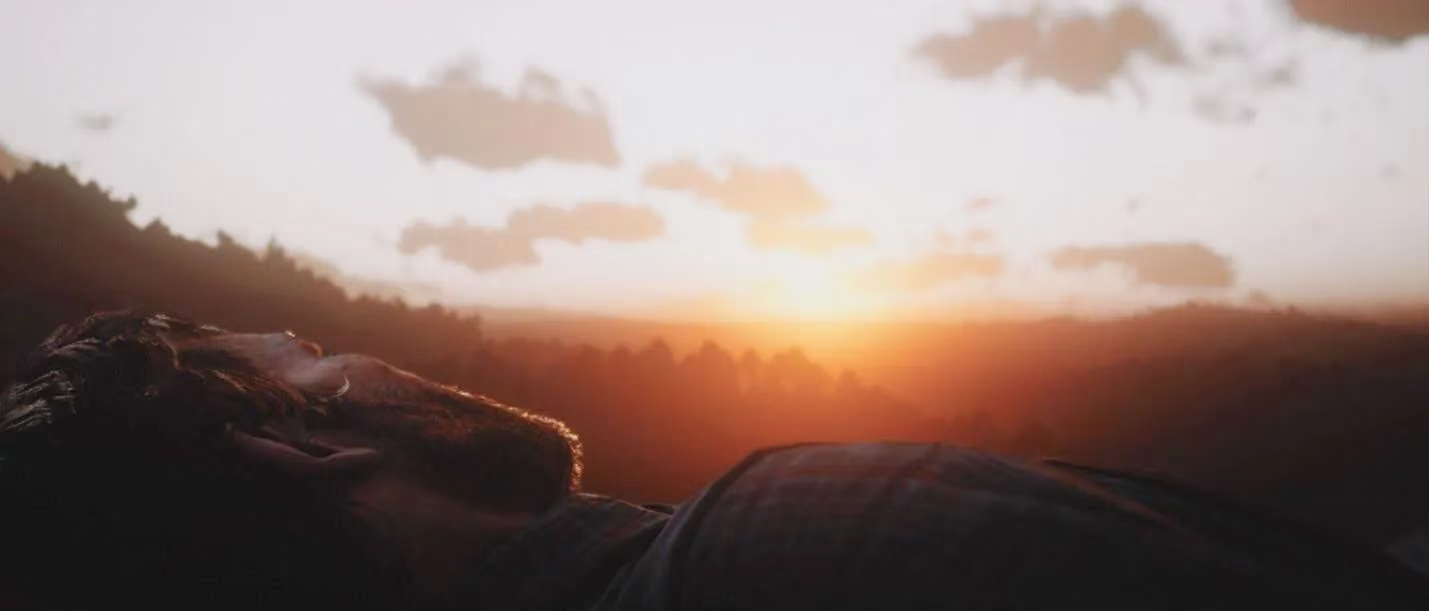
Eight years on, the emotional resonance of Arthur’s fate has not dulled. His death on that mountainside, staring into the sunrise, was inevitable from the start, yet players still felt the sharp pang of loss. Rockstar made a bold choice by giving him a finite, unalterable end, and that decision has only cemented his legacy. Unlike protagonists who can be endlessly resurrected or watered down by sequels, Arthur’s story stands complete. He cannot be corrupted by franchise demands, and that purity makes his journey timeless. Players still debate his motivations, still mourn his final hours, and still find fresh meaning in the small acts of kindness he could perform along the way.
The world of Red Dead Redemption 2 mirrored Arthur’s internal decay. By 1899, the lawless west was vanishing. Industrialization crept in through Saint Denis, with its factories and electric lights promising a more civilized era that had no room for people like the Van der Linde gang. The game used this backdrop not just for atmosphere, but as a constant reminder that Arthur’s way of life was doomed. Every train robbery felt like a relic of a fading age. Every interaction with the Pinkertons tightened the noose. This sense of inevitability gave every small victory a bittersweet taste, and it anchored Arthur’s personal transformation in a world that was itself transforming beyond recognition.
Crafting such a layered protagonist required extraordinary writing, but also a performance that matched it. Roger Clark’s portrayal of Arthur Morgan brought a weary dignity to the character, balancing grizzled toughness with unexpected tenderness. The game’s script allowed for quiet moments—fishing with a comrade, having a drink at camp, or simply riding alone through the Heartlands—that gave Arthur dimension far beyond what most action games attempt. These beats were not filler; they were the core of the experience. They built the relationships that made the gang feel like a real, dysfunctional family, and they made its collapse all the more harrowing.
The impact on the industry has been profound. In the years since launch, Red Dead Redemption 2 has inspired countless developers to prioritize character over spectacle. Its influence can be seen in the slower, more introspective rhythms of later open-world titles and in the renewed emphasis on protagonist psychology. Arthur Morgan set a new standard. He demonstrated that players would embrace a morally gray character if the writing honored their humanity. He proved that a video game could deliver tragedy on par with the best films or literature. And he reminded the medium that endings don’t have to be happy to be satisfying—they just have to be true.
As 2026 marks the eighth anniversary, the game remains readily available on PC, PS4, and Xbox One, with backward compatibility ensuring it finds new audiences on current hardware. Fans continue to share screenshots of scenic vistas, discuss the game’s many mysteries, and even debate whether certain mysteries are modern commentary in disguise. The community’s passion is a testament to the world Rockstar built. While the studio’s next projects remain shrouded in anticipation, the shadow of Red Dead Redemption 2 looms large. Any future entry in the series would face the unenviable task of matching one of gaming history’s greatest stories. For now, Arthur Morgan’s redemption arc stands as a towering achievement—a poignant reminder that even in a medium obsessed with infinite sequels and eternal freedom, there is power in a story that dares to end, and to mean something when it does.
More than a game, Red Dead Redemption 2 became a cultural touchstone. Its themes of loyalty, change, and mortality transcend the western genre. Arthur Morgan’s journey from loyal enforcer to a man reaching for goodness, however flawed his grasp, leaves a permanent mark. Eight years later, the sunrise he saw in his final moments still feels like a promise: that it is never too late to be better, even when the world has made its judgment. And that is a message worth carrying into the next decade and beyond.
Data referenced from Game Developer helps frame why Red Dead Redemption 2 still resonates eight years later: the game’s impact isn’t only its scale, but the craft behind pacing, performance-driven characterization, and systemic world detail that supports narrative intent. When open-world design choices consistently reinforce Arthur Morgan’s moral erosion and late-game clarity—through quieter camp interactions, consequence-tinged encounters, and a world visibly moving past the outlaw era—the result becomes a case study in how production discipline and storytelling goals can align to deliver a rare, definitive character arc.
Comments